
Automated Guided Vehicle (AGV)
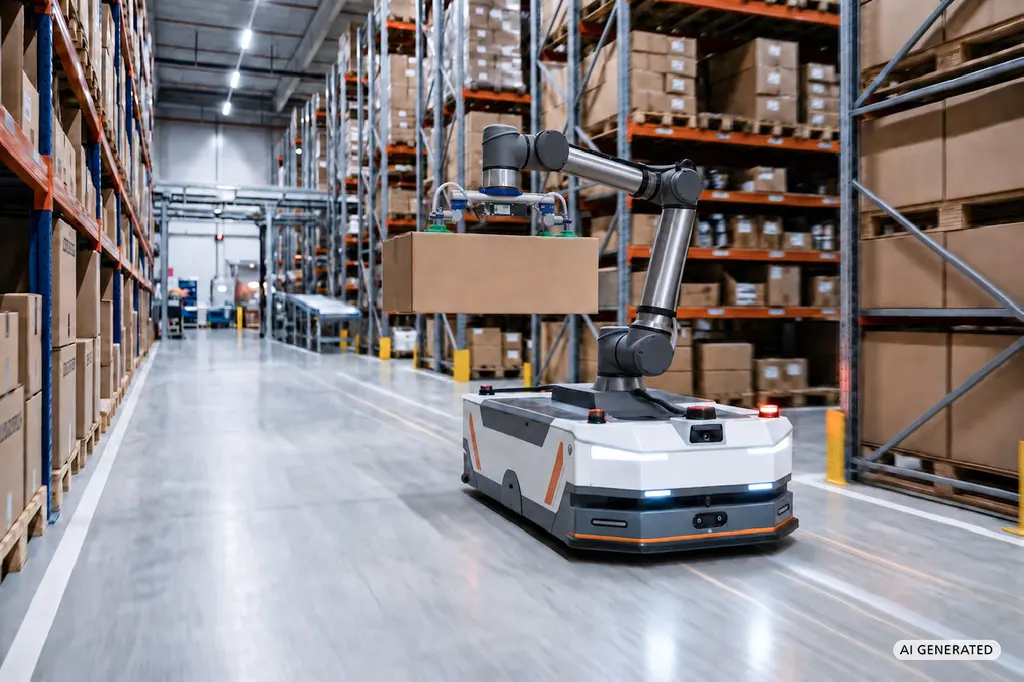
An automated guided transport system (AGTS) is an in-plant material-handling system consisting of several automated guided vehicles (AGVs), a higher-level control system, and the associated infrastructure. It transports material without a driver between designated stations in storage, production areas, and mounting lines.
- Automated Guided Vehicle (AGV)
AGV and AGVS – What Sets These Terms Apart
In common usage, the two abbreviations are often used synonymously. Technically, however, they refer to different levels:
AGVS (Automated Guided Vehicle System): overall system consisting of vehicles, fleet control and infrastructure
AGV (Automated Guided Vehicle): the individual vehicle
It follows that an AGV and an AGVS are not the same. Anyone who speaks of "an AGV" means a single vehicle, whereas anyone who speaks of "an AGVS" means the entire installation. In practice, the distinction is relevant where performance data are compared: the throughput of a system cannot be compared with the payload of a single vehicle.
What a driverless transport system consists of
An AGV system is more than just a group of vehicles. The system consists of four components:
Vehicles (AGVs): Undercarriage, pallet truck, forklift truck, or tow truck variants, designed for specific load carriers and payloads.
Control system: manages transport orders, assigns them to the vehicles, regulates traffic at intersections and bottlenecks, and monitor utilization.
Communication: The data link between the vehicles and the control system, as well as the interface to the warehouse management system.
Peripherals: charging stations, transfer stations, fire protection and gate systems, and load-handling attachments.
The performance of an AGV is usually determined not by the individual vehicle, but by the control system and the layout. Bottlenecks, one-way routes, and the number of transfer points often limit throughput sooner than vehicle speed does.
What norms and standards apply to AGVs
In German-speaking countries, the VDI 2510 series of guidelines is the authoritative standard for the planning, operation, and acceptance of automated guided vehicles. Four sets of regulations govern best practices:
VDI 2510: The foundational document of the series; it defines requirements and parameters for planning and acceptance.
VDI 2510 Part 2: Safety requirements for AGVs and mobile robots for manufacturers, integrators, and operators.
DIN EN ISO 3691-4: Safety requirements for automated guided industrial trucks and their systems.
VDA 5050: An open, manufacturer-independent interface between the vehicle and the master control system
VDA 5050 deserves special attention. The standard describes how a vehicle communicates with a higher-level control system. Those who adopt this standard can operate vehicles from different manufacturers in a single fleet and are not tied to the control system of a single supplier.
AGVs or AMRs — How the Concepts Differ
Both concepts transport material without a driver. The difference lies in the degree of autonomy:
Feature | Conventional AGV | AMR |
|---|---|---|
Route Guidance | Predefined paths | Free navigation, |
Infrastructure | Magnetic track, induction loop, or reflectors possible | No structural infrastructure required |
Obstacle in the way | Vehicle stops and waits | Vehicle drives around the obstacle |
Layout change | Infrastructure adaptation required | Software adaptation |
Typical strength | High, consistent throughput on fixed routes | Changing destinations, frequent layout changes |
This comparison describes two ends of a spectrum, not a sharp dividing line: Many modern automated guided vehicles also navigate freely and avoid obstacles. Industry associations and guidelines are therefore increasingly grouping both concepts under the umbrella term “mobile robotics.”
相关术语
常见问题
How does an autonomous transport vehicle navigate inside a building?
Depending on the system generation, automated guided vehicles navigate using magnetic tracks or induction loops in the floor, reflective markers on walls and shelves, optical markers such as QR codes, or the building’s outline without additional markings. The method chosen has a significant impact on the construction costs associated with a future layout change.
When is an automated guided vehicle (AGV) a better choice than an autonomous mobile robot (AMR)?
An automated guided vehicle (AGV) is a better choice than an autonomous mobile robot (AMR) when consistently high cycle frequencies and maximum throughput are required on fixed, unchanging transport routes.
A classic track-guided AGV demonstrates its strengths particularly under the following conditions:
Static processes: The material flow and facility layout remain unchanged for years.
High cycle rates: The size of the transport volumes moved along fixed, defined point-to-point routes is large.
Separate travel paths: The traffic area is largely kept free of pedestrian traffic and unpredictable obstacles.
Cost-effectiveness: For very simple transport tasks, the AGV often offers lower capital costs (CAPEX) and highly predictable maintenance.
What is an automated guided vehicle (AGV) typically used for?
An automated guided vehicle (AGV) is typically used for highly standardized, repetitive material transport between fixed points in production and intra-logistic operations.
Typical applications of an AGV include:
Mounting and production line supply: Cycle-timed delivery of components and raw materials to production lines and workstations.
Storage and plant transportation: Connecting goods receiving, intermediate storage areas, and goods shipping over longer, unchanging lengths within a facility.
Pallet transport: Automated handling of heavy load carriers and finished goods to the shipping area.
Process integration: Reliable transfer of workpieces between individual, physically separate processing stations.